Showing posts with label rhino. Show all posts

Tuesday, 21 May 2013

Black Rhinoceros - A Critically Endangered Species


One of the most critically endangered animals and best known for their mortal combat are the Black Rhinoceros. According to a recent study earlier this year (2013), there is an estimated population of just 4,880 individual black rhinos.

Two black rhinos (mother and calf) in Lewa, central Kenya
Source: By Harald Zimmer (Own work) [GFDL (http://www.gnu.org/copyleft/fdl.html), CC-BY-SA-3.0

Where do these Black rhinos live? They live in the tropical and subtropical grasslands, savannas,  deserts and are native to Central and Eastern Africa.

Range or distribution of black rhino
Source: rhinoresourcecenter.com

The black rhinos have a dark grey or brown skin and can weigh from 800 to 1,400 kg. They have two horns that they use for defense and to dig roots and break branches while eating.


Rhino species size comparison Indian Rhinoceros, over 1.8m White Rhinoceros, 1.8m Black Rhinoceros, over 1.5m Javan Rhinoceros, 1.5m Sumatran Rhinoceros, 1.4m
Source: By WikipedianProlific [GFDL (http://www.gnu.org/copyleft/fdl.html) or CC-BY-SA-3.0


Did you know? These black rhinos are also called the hook lipped rhinos because of their pointed upper lip.

Black rhino, you can see the pointed upper lip
Source: arkive.org

Their eyesight is poor and can hence attack tree trunks and termite mounds thinking that they are threats. However they identify food, other rhinos and predators with their sense of smell and hearing, both of which are great.

They go to regular areas for resting and wallow in the mud during the day to cool off their body and to ward off insects and parasites.


Black rhino wallowing in the mud
Source: arkive.org

These solitary black rhinos come together only for breeding and sometimes conflicts occur between males over a female, resulting in the death of a male!!!

The female rhinos give birth to one calf and look after the calf for 2 to 3 years. These rhinos live for around 30 to 35 years in the wild and around 45 to 50 years in captivity.
 

Black rhino and its calf at St Louis zoo,
Source: zooborns.com

To read more about the Black Rhinos, their characteristics, behaviour, food, habitat, reproduction, threats they face, actions taken to protect them and other facts in detail, please follow the link below.

Black Rhinoceros - A Critically Endangered Species

Threats faced by the Black Rhinoceros:
  • Killed for food and fun in the early 20th centuries
  • Change in habitat
  • Illegal wildlife trade, especially for their horns
  • Poaching
  • Traditional medicines

Poached black rhino
Source: panda.org

Conservation efforts taken to protect the Black Rhinos:

WWF and other conservation programs are working towards,
  • Stopping poaching and illegal trade
  • Trans-location programs like Flying Rhinos
  • Anti poaching patrols
  • Transmitters to track rhinos
  • Reintroduction programs

Flight of the rhino, flying rhino
Source: savetherhino.org

How can you help?


You can help by:


  • Adopting a black rhino
  • Donating to the WWF
  • Spreading the word about the plight of the rhinos
  • NOT buying any rhino products
  • Buying only FSC certified forest products


Did you know? More than fifty percent of male rhinos and more than thirty percent of female rhinos die from injuries related to combat!!!

Livingsta

Thank you for stopping by. I hope that you found the information presented here useful.

Have a great week!

Peace...

Livingsta :-)

Thursday, 16 May 2013

Javan Rhinoceros - A Critically Endangered Species


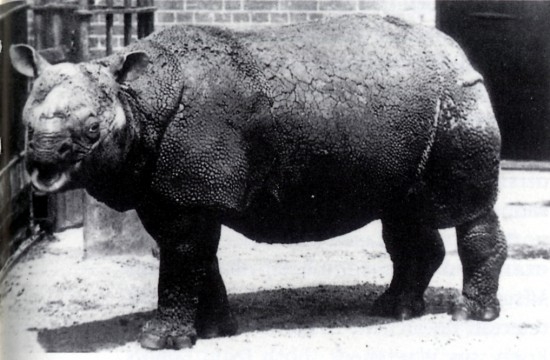
The Javan rhinos are one of the most critically endangered species in the world. There are only around 35 individuals in the wild and that too in protected areas. 

Javan Rhino
Source: By T.Dixon. The Zoological Society of London [Public domain], via Wikimedia Commons


They are found in the tropical forests and the only population that exists now is in the Ujung Kulon National Park in Java, Indonesia

Range of the Javan Rhino
Source: By JayHenry, Thaisk Việt hóa (Own work) [CC-BY-SA-3.0 (http://creativecommons.org/licenses/by-sa/3.0) or GFDL (http://www.gnu.org/copyleft/fdl.html)], via Wikimedia Commons


Did you know? They are the most endangered of the 5 threatened rhino species in the world.


The scientific name for the Javan Rhino is Rhinoceros sondaicus

Ujung Kulon National Park in Java, Indonesia
Source: gogobot.com

You can read more about the Javan rhino, its characteristics and behaviour, food and habitat, reproduction process, threats and reasons why they are endangered, conservation efforts and facts in detail if you follow the link below.

Javan Rhinoceros - A Critically Endangered Species

They have a horn that is made of keratin and it grows to a maximum length of 25 cm. They have poor vision but good sense of smell and hearing.

Anatomy of Javan Rhino
Source: worldwild.org

They can run at a speed of 30 mph. They are solitary animals and get together only for breeding.

These Javan rhinos like other rhino species, wallow in the mud to get rid of parasites and to cool their body. They live for around 30 to 45 years in the wild and do not survive well in captivity.

Javan Rhino
Source: arkive.org

The Javan Rhinos are herbivores and they eat fruits  leaves, tender stems etc. They also visit salt licks as they need salt in their food.

The female Javan rhino gives birth to one calf every 3 years and the gestation period is 16 months according to reports.

Arenga Palm
Source: tropical-biology.org


Main threats for the Javan rhinos:

  • Natural catastrophes
  • Diseases
  • Inbreeding due to low population
  • Hunting by humans for illegal trade - Rhino horn is NOT medicine
  • Arenga palm invasion in rhino habitat
  • Human settlements
  • Forest clearing for agriculture

and many more...

Please follow the link below to read more in detail about the Javan rhinos

Javan Rhinoceros - A Critically Endangered Species

WWF is working with other conservation organisations to help save the Javan rhino species from extinction. If actions are not taken they could be extinct in another few years.

Did you know? A group of rhinos is called a crash or a herd!!!

Extinction is forever; So let us help save our planet by saving the life of the endangered species from extinction!


What can you do to help?

  • You can adopt a rhino
  • You can donate to the WWF
  • Please do not buy rhino products and buy only FSC certified forest products and certified sustainable palm oil.
  • Last but not the least, please spread the word about the threats that the Javan rhinos are facing


I hope you all enjoyed reading this as much as I enjoyed writing this. 

Sending you all blessings...

Peace

Livingsta :-)